
For some time now, I’ve been chewing the fat with colleagues and friends (Richard Hall, Geoff Hughes and Dionne Barton) about blogging, its benefits and challenges, with the aim of rekindling the habit of writing again. With a bit of discipline, blogging can be cathartic, as it helps to form, strengthen, express and test ideas that would otherwise bounce around in the mind and eventually purge away from memory.
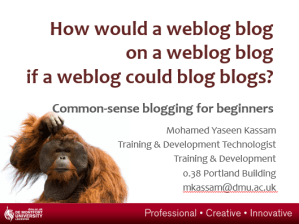
To (re)start somehow, I thought I’d use a heading from the title of a staff training session I had written and delivered some years back. The title of the session actually came from (or shamelessly ripped-off from) a greeting card that someone had given to me for something or the other. I didn’t write much before or after the session about blogging, and alas, the idea got waylaid, until today.
The line on the greeting card stood out because it had a quite nice play around the terminology* surrounding blogging, and it seemed perfect for the session I was about to deliver. My intentions then for the session was not only to inform and inspire colleagues about blogging, but also give me impetus to continue blogging. Several colleagues reported that they had started a blog and my blogging flourished too.
However, I had also warned in the session, that blogs did not get the required nurturing i.e. purpose, discipline, commitment, consistency, and a persistent eagerness to say something, then they would not transpire into anything.
I continued earnestly with a blog or two, but the habit did not remain; I always felt a sense of burden to have to log on to a computer, open a browser, log-in and write, publish, when you had that lightbulb moment. Perhaps I lacked an attribute or two mentioned earlier, however I felt that the technological barriers to blogging, pre-smartphones and tablets, made writing at the spur of the moment difficult. Blogging waned for many people as it did for me, and I ended leaving just the one blog going for the occasional muse and academic writing.
“For all the blogs that become successful, there are hundreds more that have been abandoned over time.
These now empty spaces that once represented someone’s dreams; their lives distilled into a series of carefully constructed articles that quietly grow dust.”
However, over time whilst DVDs, instant messaging, and MP3 players slowly withered away during the last decade, blogging did not. People of great standing, especially in the EdTech community continued to highlight the virtues of blogging, especially for self-development. The likes of Stephen Downes, an internationally renowned voice on all things online learning and MOOCs, keeps at least half an hour aside a day to write on a blog. He also writes and maintains the hugely popular OLDaily blog, and in one recent post, Downes said:
“I wouldn’t have a career without blogging. And for all my professional output, my blog posts are the best of me.”
– Stephen Downes – OLDaily
Similarly, recently Martin Weller shared his sentiments about blogging in his Inaugural Professorial Lecture at the Open University; Weller said that blogging helps develop an academic identity and create connections, and that blogging was one of the best academic decisions he had made.
In a similar vain, yet another blogger had written recently:
“When you blog, you’re building up a body of work that represents you online. It’s a gateway into your thought process more than anything else. So do what moves you…. The only thing that’s really important is that you keep doing it. I can tie every single major advance in my career to blogging. It’s been hugely important in my personal life, too. I couldn’t recommend it more.”
– Ben Werdmuller, The best way to blog in 2020
So blogging is important for those that have (or developing) a voice and the will to say something. More so for people who dabble in rapidly shifting spaces like EdTech like I do. For centuries, when people wanted to express their thoughts and ideas widely, they needed contacts, influence and power. Now, equipped with an internet connection and free platforms such as WordPress, writing and expression of ideas, by and large, is so much easier.
And so in the words of Audre Lorde, the civil rights activist, who said:
“I have come to believe over and over again that what is most important to me must be spoken, made verbal and shared, even at the risk of having it bruised or misunderstood. That the speaking profits me, beyond any other effect. So I will keep on speaking.”
…and I will keep on blogging…
…here goes!
*Blogging Terminology
Blogger (noun) – A person who keeps and updates a blog.
Blog/Weblog (noun) – A shared on-line journal where people post daily entries about their personal experiences, work, interests and hobbies.
Blog (verb) – Read, write, edit, and share and online journal (or blog).

 LearnViaTech